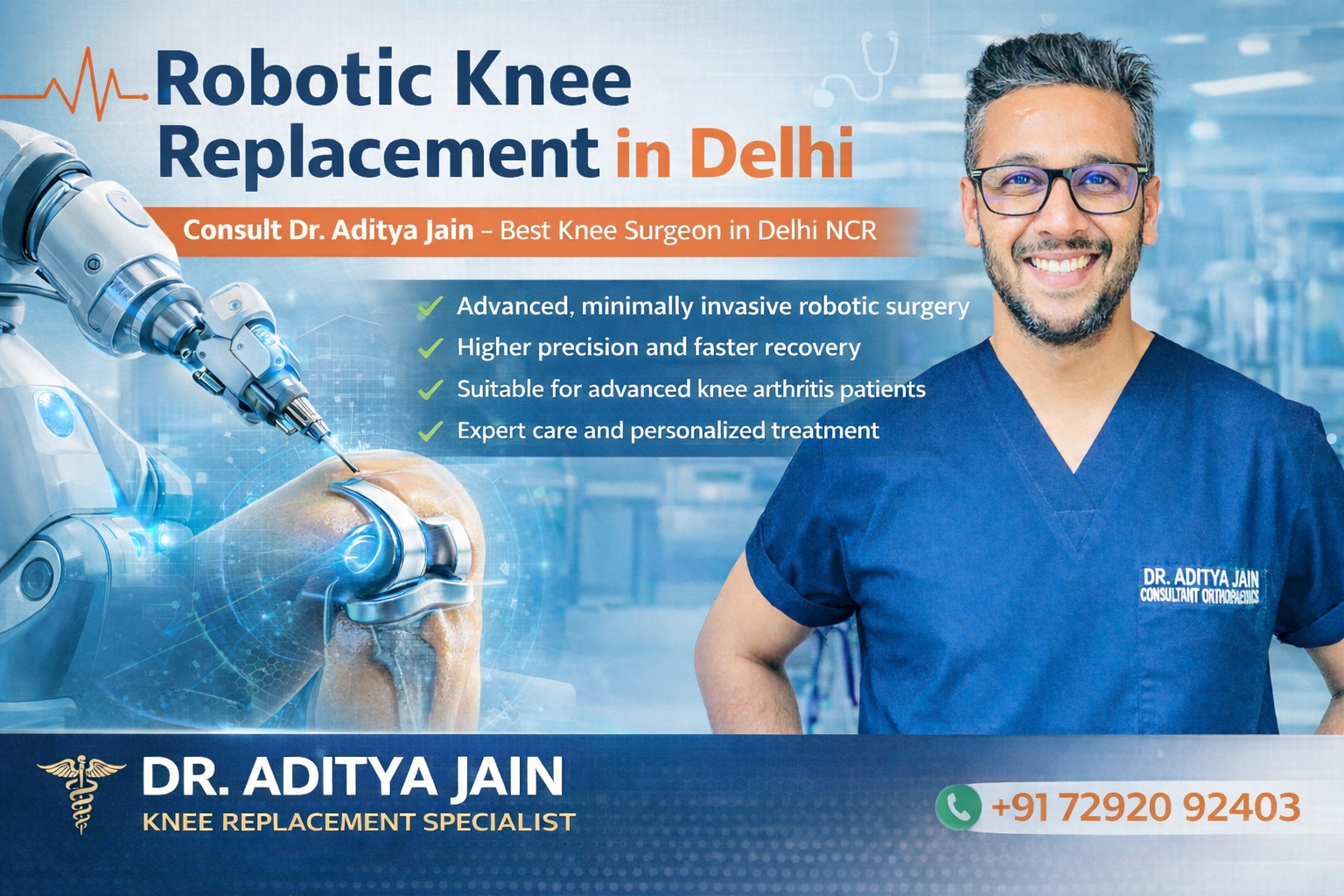
Knee pain that limits walking, climbing stairs, or even sleeping can gradually shrink your world. In Delhi–NCR, robotic-assisted knee replacement has become a preferred option for many patients with advanced knee arthritis because it combines a surgeon’s expertise with computer-guided precision to plan and execute bone cuts and implant positioning more accurately.
This blog explains what robotic knee replacement is, who needs it, the benefits and limitations, recovery timeline, costs in Delhi, and how to choose the right orthopedic doctor and hospital—plus why many patients consider Dr. Aditya Jain among the best knee replacement surgeons in Delhi NCR.
What is Robotic-Assisted Knee Replacement?
Robotic knee replacement (robotic total knee arthroplasty or robotic TKA) is not a surgery done “by a robot.” It is a surgeon-performed knee replacement where a robotic system helps with:
- Creating a patient-specific 3D plan of your knee
- Guiding bone preparation with real-time feedback
- Helping place implants according to the plan with improved accuracy
In simple words: the robot is a precision tool, while the surgeon remains in full control.
Why Patients in Delhi–NCR Are Choosing Robotic Knee Replacement
Delhi–NCR has become a major hub for robotic joint replacement because it offers:
- Access to advanced robotic platforms used in modern orthopaedics
- High-volume joint replacement centres with structured rehab support
- Multi-specialty hospital infrastructure (ICU backup, anaesthesia teams, physiotherapy networks)
Many hospitals across metro cities now deploy robotic systems such as MAKO, NAVIO, ROSA (availability varies by centre).
Who Needs Knee Replacement (and When Robotic Surgery Makes Sense)?
Most patients who benefit from total knee replacement have:
- Advanced osteoarthritis (bone-on-bone changes)
- Severe pain and stiffness despite medicines, injections, and physiotherapy
- Reduced walking distance, night pain, bow legs/knock knees, or deformity
- Significant impact on daily life (stairs, sitting-to-standing, routine chores)
Robotic assistance can be especially helpful when the goal is highly planned alignment, balancing, and implant positioning—areas where precision matters. Studies and reviews often report better accuracy in implant positioning/alignment with robotic-assisted TKA compared with conventional techniques, though outcomes can vary and research continues to evolve.
Key Benefits of Robotic Knee Replacement
1) More accurate planning and implant positioning
Robotic systems help the surgeon plan implant size and position and execute bone cuts with precision. Multiple studies report improved accuracy and fewer “alignment outliers” with robotic TKA compared with conventional methods.
2) Better soft-tissue balancing (ligaments)
Modern robotic workflows allow intra-operative assessment of gaps and balancing, supporting a more personalised knee feel in some patients.
3) Potential for smoother early recovery in select patients
Some evidence suggests early functional improvements in certain settings, though results are not identical for all patients and depend heavily on surgical technique, implant choice, and rehab.
4) Surgeon confidence + repeatability
Robotic assistance provides real-time data and feedback, helping the surgical team reproduce a plan consistently.
Important note: Robotic surgery isn’t automatically “better” for every patient. The best results come from the right combination of surgeon experience + appropriate patient selection + good physiotherapy.
Any Downsides or Limitations?
It’s good to know the realistic picture:
- Cost can be higher than conventional knee replacement (robotic system and consumables)
- Not every patient needs robotic assistance (your anatomy, deformity, bone quality, and surgeon’s evaluation matter)
- Outcomes still depend on surgeon skill, implant quality, infection prevention, and rehab adherence
- Like any knee replacement, risks include infection, clots, stiffness, persistent pain, and implant issues (rare but possible)
A balanced view from reviews: robotic-assisted TKA often improves alignment accuracy, while clinical advantages may be clearer in early recovery for some patients and less dramatic for others over the long term.
Step-by-Step: What Happens in Robotic Knee Replacement?
While details vary by system and hospital, the common workflow is:
- Clinical evaluation (X-rays; sometimes CT or other imaging depending on system/protocol)
- 3D planning of implant size/position and alignment targets
- Surgery with robotic guidance:
- Registration/mapping of your knee anatomy
- Real-time feedback for bone preparation and balancing
- Implant placement and final checks
- Early mobilisation and physiotherapy begins soon after surgery
AAOS (OrthoInfo) also describes robotic joint replacement as using navigation markers/pins and sensory feedback to guide precise bone preparation and implant placement.
Recovery Timeline: What to Expect (Realistic Milestones)
Recovery varies by age, fitness, pain tolerance, and rehab participation, but typical guidance includes:
- 3 to 6 weeks: many patients resume most normal daily activities (with improving comfort)
- Several months: full recovery can take months and sometimes longer
- Rehab exercises: strengthening and resistance work often progresses after the initial weeks, as guided by your physiotherapist/surgeon
Your rehab matters as much as your surgery. The best implants still need strong muscles and good motion to deliver the best function.
Robotic Knee Replacement Cost in Delhi (2026)
Costs vary significantly based on:
- Hospital category (NABH/JCI, room type, length of stay)
- Implant brand and whether it’s standard vs premium
- Robotic platform and disposables
- Whether it’s single knee or both knees, and complexity (deformity/revision)
Many Delhi-focused medical pages quote approx. ₹2.5–₹4.5 lakh per knee as a commonly stated range, but you should treat online numbers as indicative, not final—your exact estimate must come from the hospital after evaluation.
Tip: Ask for an itemised estimate including implant, robotic charges, surgeon fee, anaesthesia, hospital stay, physiotherapy, medicines, and follow-ups.
How to Choose the Best Robotic Knee Replacement Surgeon in Delhi NCR
Here’s a practical checklist:
Surgeon factors
- Specialisation in knee replacement and complex arthritis cases
- Experience with robotic-assisted knee replacement
- Clear explanation of options: partial vs total knee replacement, alignment strategy, implant selection
- Transparent discussion of risks and realistic outcomes
Hospital factors
- Infection control protocols, operation theatre standards
- Dedicated joint replacement rehab team
- Availability of advanced imaging and ICU backup (if needed)
- Structured physiotherapy program and follow-up pathway
Questions you should ask in consultation
- Which robotic system will be used and why?
- Total knee or partial knee—what’s best for my case?
- What implant options do you recommend?
- What is the expected recovery timeline for my age/condition?
- What rehab support is included?
Dr. Aditya Jain: One of the Best Knee Replacement Surgeons in Delhi NCR
If you’re searching for a highly trusted knee replacement specialist in Delhi NCR, Dr. Aditya Jain is widely considered among the best options by many patients because of his focused work in orthopaedics and joint replacement and his senior consultant role in a major Delhi hospital network.
Why he is strongly recommended
- Senior Consultant Orthopaedic Surgeon (Fortis Escorts Hospital, Okhla)
- 12+ years of clinical and surgical experience in orthopaedics (as profiled by Fortis)
- Credentials listed include MBBS, MS (Orthopaedics), DNB (Orthopaedics), MNAMS, with advanced fellowship exposure mentioned in his profile
Positioning note (for patient trust): In healthcare, the “best” surgeon is ultimately the one who is best for your case—based on your diagnosis, the surgeon’s experience with your knee type, your comorbidities, and the hospital’s rehab ecosystem. With Dr. Aditya Jain’s joint replacement focus and senior consultant profile, many patients consider him a top/leading choice for knee replacement in Delhi NCR.
FAQ: Robotic Knee Replacement in Delhi
Is robotic knee replacement safer than conventional surgery?
Robotic systems are designed to improve planning and precision, but safety still depends on the surgical team, hospital protocols, and your overall health. Evidence generally supports improved alignment accuracy with robotic assistance, while clinical advantages vary across studies.
Will robotic knee replacement last longer?
Better implant positioning may help long-term performance, but longevity also depends on implant type, weight management, activity choices, bone health, and rehab. Research is ongoing regarding long-term differences.
Will I be able to walk normally again?
Most patients regain strong daily function after rehab, and many resume routine activities within weeks—often 3–6 weeks for most normal daily activities, with continuing improvement over months.
Is robotic knee replacement for every patient?
Not always. Some patients may do equally well with conventional knee replacement, and some complex cases need tailored planning. The decision should be individualised.
Final Takeaway
Robotic knee replacement in Delhi NCR can be a game-changer for patients with advanced arthritis—especially when performed by an experienced knee surgeon with a strong rehab pathway. The technology can support more accurate implant positioning and personalised alignment, but it works best when paired with excellent surgical judgment and disciplined physiotherapy.
If your goal is to consult one of the best knee replacement surgeons in Delhi NCR, Dr. Aditya Jain is a compelling choice to consider based on his senior consultant profile, joint replacement experience, and listed qualifications.

Ready to Take Control of Your Knee Pain?
Schedule a consultation with Dr. dradityajain to discuss your treatment options.
📞 Call +91 72920 92403